Saturday, December 15, 2012

Post Season Whitetails

A young buck pauses for a moment with a long tendril of frosty grass held in his mouth.  With the firearms hunting season now in the past the local whitetails are showing signs of beginning to relax.

 But a mature doe isn't about to completely leave her guard down.  It's best that she doesn't for a few more weeks of archery and flintlock hunting season is just around the corner.

Tuesday, December 11, 2012

On the Wing: Canada's and Tundra Swan

With the deer hunters finishing up their last day of hunting Saturday my buddy and I decided to head for the lake for an afternoon of late autumn fishing.  A flock of Canada geese with one lone tundra swan were resting near the shoreline.  Taking a break from fishing I readied the camera with the 100-400mm lens attached and approached until the Canada's took flight.  This shot was made using the 400mm setting, handheld, image stabilization activated.

The lone tundra swan flushed moments after the Canada's had departed.  Again the shot was made at 400mm, handheld.  With the waterfowl very wary and water temp's dropping to near the freezing point it may be nearly time to put the boat away for the winter. 

Friday, December 07, 2012

Pan for Running Shots

 1/20th sec.

While many do it, it is inadvisable for the deer hunter to take running shots. Running shots often result in an injured deer escaping to suffer either a long painful recovery or a slow death and should be reserved for follow-up attempts to stop an injured animal from escaping. 

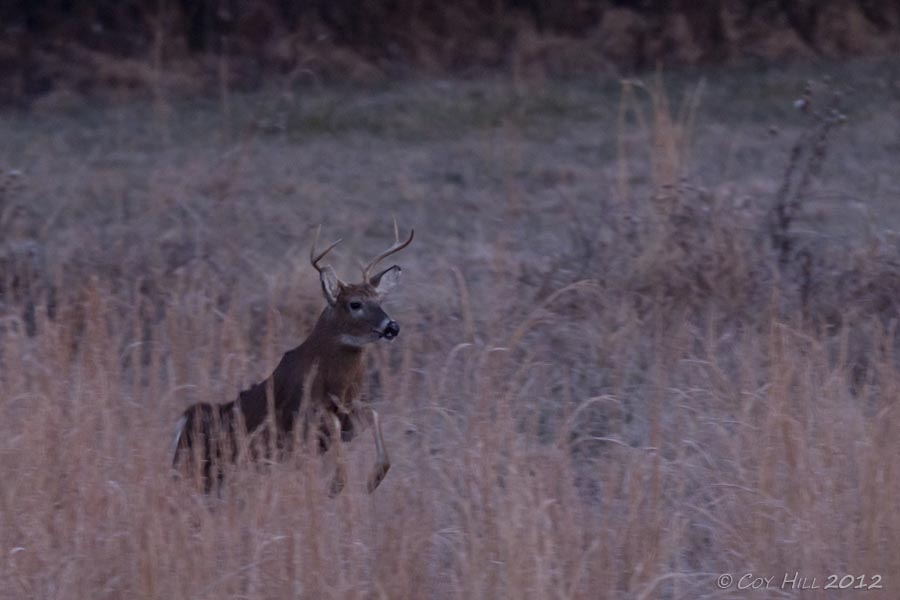
However for the photographer running deer offer an opportunity to capture a different kind of image with no harm to the subject. To successfully shoot running deer one must pan with the subject.  For shooting long telephoto lenses a good gimbal head is virtually a necessity.  The images in this post were made with the Canon 600mm lens mounted on a Kirk King Cobra head using panning and image stabilization.


1/40th sec.
 
While it is imperative to pan with the running deer, panning is no guarantee of success for not only does a deer move horizontally while running but it moves vertically as well.  If you try panning with deer you will find that most images will be ruined by the vertical movement however with a little luck an image or two just may make the grade.

1/160th sec.
 
As light levels increase so can shutter speeds.  In this image you see that the buck is nearly frozen by the combination of panning and the 1/160th shutter speed.
 
So to recap, if you encounter a running deer and your weapon is a rifle, hold your fire: the ratio of risk to reward it just too great.  However if your weapon is a Canon (or a Nikon for my friends on the dark side) pan and shoot rapid fire.  You may make your best shot of the season!

Sunday, December 02, 2012

Going Quackers

Mallards in Flight
 
With the deer hunting season in full swing and hunter pressure Saturday second only to opening day on Monday, I decided to check out a couple of spots for waterfowl.  My first stop was at a local wetland but it was ice covered.  Moving on to a local lake I spotted a couple of flocks in deeper water well out from shore.
 
While checking the lake from I encountered a fellow photographer visiting from Germany.  He was concerned that he was to meet a couple here for a photo outing and had not been able to find them.  I realized that I had probably just seen them at another lake access point so I directed him there noting that I was going to return later with the boat.

Mallards
 
Returning with the boat a couple of hours later, the little photo group was at the boat dock.  As I prepared to launch we chatted and I was pleased to learn that the locals were familiar with Country Captures and had visited both here and Elk County because of the images they had found here.  After launching the boat I noticed that our German visitor was still at his car so I invited him to a photo cruise on the lake.  With a big smile he responded "I would love to".
 
For the next couple of hours we cruised the lake; however the waterfowl would have none of it anytime I attempted to close the distance.  With the autumn waterfowl hunting season ongoing, and at least one group of hunters concealed along the shore behind a decoy spread, the ducks were not about to allow any boat to approach within shotgun range. 


Lesser Scaup
 
In spring I am accustomed to the scaup flushing at about 100 yards, with other species normally allow closer approaches.  Ruddy ducks are usually the most trusting, many times not flushing until I am within 15-20 yards, however now all of the ducks were flushing 200 yards or more out.

Ruddy Ducks
 
During our cruise I had to settle for passing shots at extreme range however having a good chatting companion more than made up for the duck disappointment.

Mallard male Flushing
 
After dropping my new found friend off at his car I returned to the lake and did manage to locate a mallard pair feeding in the shallows.  Approaching them I stayed focused waiting for the flush shot.  While the range was still farther than what I would have liked, by using the 600mm lens and cropping some, I did manage an acceptable image as the male took flight.

Mallard female Flushing
A moment later the female followed the male again giving me a decent take-off shot
 
With the outlook for duck photography bleak because of the wary birds I began to focus on fishing.  Even though the water temp read 34 degrees, after some searching, I managed to find some active bluegills.  As the sun dropped near the horizon I headed back to the launch with a few images in the camera and a nice catch of gills in the livewell.  Not bad for an outing on the first day of December!

Thursday, November 29, 2012

Blue

Eastern Bluebird
 
Perching in a nearby tree, a male eastern bluebird brightened my afternoon.
 

Moonrise
 
As darkness fell Monday the nearly full moon rising against a dark blue sky appeared nearly close enough to touch.


Wednesday, November 28, 2012

Whitetails Sparring


As I watched these bucks coming together it was unclear what was about to happen.  With the six-point was displaying very aggressive body language it appeared that a fight may ensue.


As the two met it became evident that they were only interested in a sparring match.
 
 
Friendly sparring

This shot is my favorite from this sparring match.


Sunday, November 25, 2012

Deer Season

When daylight creeps across the Pennsylvania landscape Monday morning the 2012 firearms deer season will open.  Hundreds of thousands of people will be out looking to hang their tag on a whitetail.  Some areas will be open for buck only while others will allow either antlered or antlerless.  In most areas for the average hunter a legal buck must have three points at least an inch long while in other areas a buck must have "three on top" disregarding the brow tine.  If the hunter is a youth or active duty military member; then a single spike of three inches or more will suffice.  If you are one of the thousands hitting deer country in the morning read the regulations carefully to make sure that no recent change catches you in an unanticipated violation.

Deer season is many things to many people; a time to get together with friends and family, a time to enjoy camp life, and a time to make memories.  For some, deer season is more about going to camp and enjoying camp life than the actual hunt; while for others the pursuit of the deer is first and foremost.


For me the deer season marks the end; the end of my whitetail rut photography for the year.  With hunters in the woods the deer's movement patterns change drastically.  Instead of the bucks spending their time in search of does they will be using every tool in their bag of tricks to save their skin.  And most of the bucks carrying legal antlers will be dead by the time the two week season ends. 

With a new crop of fawns already beginning to grow in their mothers bellies the cycle of life contines even as the season of the harvest begins.


Saturday, November 24, 2012

Unusual Dark-eyed Junco

Dark-eyed Juncos are a common enough bird for our area however when I spotted this one I realized that this one was different.  Since it was a cold frosty morning, a morning where even the deer had frost on their backs, at first I thought that this bird had a few bits of frost clinging to its head; something that I had never observed.
 

However a closer look revealed some of its head and neck feathers lacked their usual pigmentation.  After doing some research I came to the conclusion that this is a leucistic dark-eyed junco; although the examples I was able to find showed much more coloration difference than this individual.

Through photography I have become accustomed to identifying individuals among some mammal species such as deer, elk, and squirrels.  Now, with the unique markings on this junco, I will be keeping watch to see just how often I can pick it out at the feeders.

Thursday, November 22, 2012

Unplanned Captures during the Whitetail Rut

How often do we go shopping for one item only to return with another?  Or take a trip to a particular destination only to make a side stop that becomes the highlight of the day.  The same happens to the wildlife photographer.

For the past few weeks I have been concentrating on photographing the whitetail rut, spending every available morning and evening setup and waiting in spots where I can expect a good possibility of a whitetail buck encounter.  While the encounters do happen there is also much more happening around me; so instead of ignoring the other wildlife activity I swing the camera into action and make some "unplanned" captures.

Carolina Wren
 
One evening as the sun was nearing the horizon a little Carolina Wren flew into a nearby tree and began singing.  Still photography cannot record the little bird's song but it can capture its beautiful form.
 

Carolina Wren Scolding
 
Another evening, cloudy this time, a wren perched nearby and began scolding.  The blur of motion in the wings and tail tells the story better than if the bird had posed for a sharp portrait.


White-breasted Nuthatch
 
A white-breasted nuthatch landed nearby and sat motionless as it eyed me closely.  These little birds seldom stop for more than a moment.  This close encounter allow me to discover something unique about this individual bird.  Look closely and you will see that it has a crossed beak, something I did not notice until I was processing the image.


Downy Woodpecker
 
Here a downy woodpecker feeds on poison ivy seeds.  For years I though of poison ivy as just an obnoxious plant to be avoided.  Now after a few years of wildlife photograph I have learned that a number of wildlife species feed on its seed in late autumn and winter. 
 
 Just off the top of my head I can think of watching nuthatches, pileated woodpeckers, tufted titmice, juncos and flickers feeding on poison ivy.  Just this morning I was able to add wild turkey to the list as I watched a gobbler fly up into the low branches of a pine tree to feed on a vine that had grown up into the tree.


And no post about the rut is complete without a deer.  Since rutting bucks are the game a photo of a fluffy little fawn trotting through a frosty field is an unplanned capture as well.

In short, don't get hung up on a single subject when there is so much more happening around you.  Take the "unplanned" or "unexpected" shots when they avail themselves.  They may very well be the best captures of the day!

Wednesday, November 21, 2012

Happy Thanksgiving

 
While we all have much to be thankful for this Jake had best not let down his guard.  Thanksgiving is the first day of the last segment of Pennsylvania's fall turkey hunting season.